
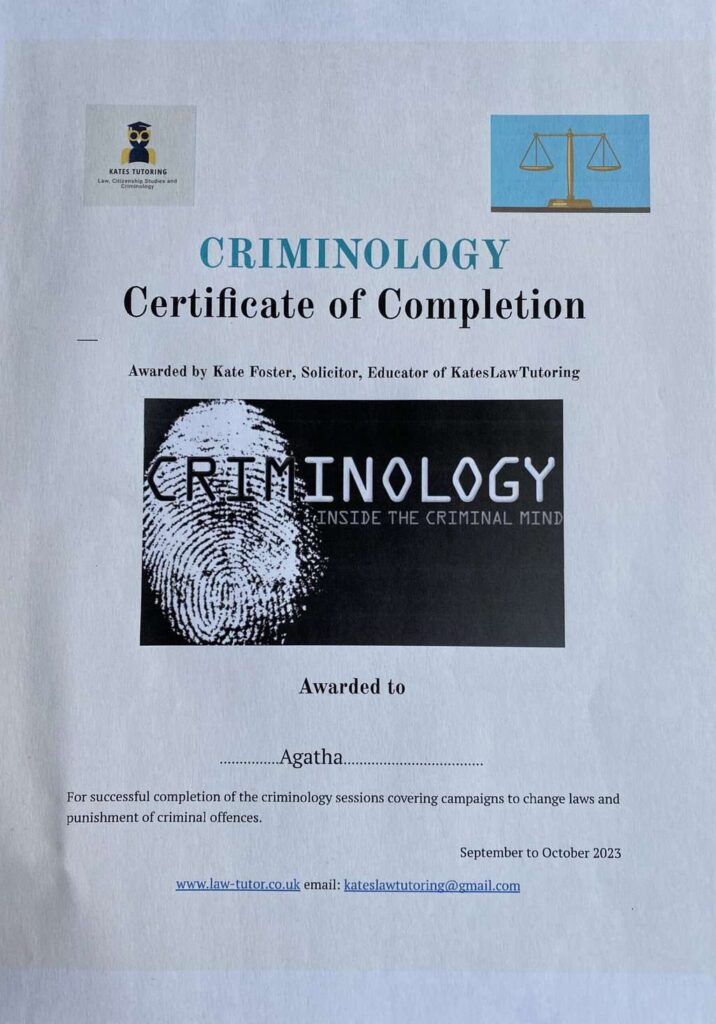
Over the past 5 weeks, I have been following an online criminology course run by Kate of Kates Law Tutoring. I have really enjoyed the live sessions and finding out more about the subject. I became interested in law and crimes after we took part in a mock trial at The National Justice Museum and after visiting the Bradford Courts open day. I can’t study law until A Level so doing courses run by Kate is brilliant until I go to college. I really enjoyed the end part of the course when we read through the case notes of a burglary and decided as a group what sentence the offender should get. Kate then told us what would have happened if it had been in real life; we were all pretty close!
It’s also really interesting tying in this side of law with what I’m learning about in criminal psychology on my Psychology GCSE course.
I’ve signed up for another criminology course next term and we’ve bought a pre-recorded course too so I’ve got lots more law and criminology to come. It’s amazing to learn from someone who has so much real-life experience and can talk from both the defence and prosecutor point of view.
Here are a few of the most interesting facts that I learnt about on this course which surprised me:
- There are 85,000 prisoners in the UK, 3,216 of which are women. However, there are only 81,000 prison spaces in the UK.
- There used to be a law called double jeopardy which meant if you were found not guilty of a crime you couldn’t be tried again for the same crime. This law was abolished in 2003.
- There are five main aims of sentencing: punishment, rehabilitation, reparation, public protection and crime reduction.
- In 1988, a lady called Helen McCourt was murdered by Ian Simms, who never told anyone where he put her body. He has since died so the location of her body is still unknown. Her mum petitioned for the creation of Helen’s Law, which now means a murderer cannot be granted parole until they have disclosed where the body is.