
On this page
Both girls will be doing English Literature GCSE and so Shakespeare will be a feature in our lives for a while. But actually, we don’t mind that at all. The girls have been exposed to Shakespeare from an early age thanks to CBeebies/CBBC productions on TV and to films based on his plays so it’s not something they dread or fear like some children.
Macbeth
Agatha asked to “do some Shakespeare” and since Halloween was just a few weeks away, I thought it would be good to look at Macbeth. I also studied this at GCSE so had vague memories about the storyline, the characters and the themes.
Macbeth resources
- Macbeth Planning Notes PDF – created by us
- Macbeth retold by Andrew Matthews/Tony Ross
- Macbeth (original text), William Shakespeare
- Macbeth, York Notes Study Guide for GCSE
We were joined by our home ed friend Eva for this topic so I aimed the work at the age range 9 to 12. We looked at Shakespeare in general first: his life, the era he lived in and some of the other plays he wrote as the girls didn’t know much about him.
We then focused on the story using an abridged version of the play in modern English. I wanted to be sure the girls understood the plot and got to know the characters; I didn’t want the Shakespearean English to put them off. We then dipped into the original text for scenes involving the witches. Since working through this topic, Agatha has decided she wants to read more of the “proper version” and so is currently working her way through the entire play using the original text and the York notes.
In this topic we have:
- Learned about Shakespeare and the times he lived in
- Learned about iambic pentameter
- Read through the play in abridged modern English
- Looked at how the witches look in different productions
- Learned Act 1 Scene 1 off by heart
- Created our own wooden spoon puppets
- Written a newspaper report
- Written and filmed a TV news report
- Learned about what was eaten at medieval banquets
- Made royal bread and peasant bread
- Learned about medieval cures for various illnesses
- Looked in detail at the witches’ spell and then wrote our own
- Made some “magic” colour changing potions for our cauldrons
- Written a speech for King Malcolm using persuasive writing
- Learned about some famous battle music
- Looked at the themes and characters throughout the play
- Created Macbeth top trumps
- Watched the film Macbeth (2015)
Overall, we’ve really enjoyed doing this topic. We’ve done a really good mix of activities which has kept things interesting. I’ve given the girls a taste for Shakespeare and they both want to go on to do another play so it’s been successful. By focusing on the story and characters of the plays, I hope to give them a good understanding appropriate for their age. I was very conscious of not overloading them with line-by-line analysis as I’m pretty sure that would kill any enthusiasm for Shakespeare!
To see in detail what we’ve done, here are my detailed planning notes with links to all the resources we’ve used. Please feel free to download it and edit it to suit your own children. If you would like to share this resource with others, please share the link to this page rather than just sharing the word document.
Julius Caesar
As with a lot of our activities, one thing leads to another. A planned visit to Guide Dogs’ National Centre turned into a couple of days away in Stratford-upon-Avon and then a performance of Julius Caesar at the RSC.
Julius Caesar resources
- Twinkl’s KS2 All About Julius Caesar PowerPoint
- Abridged Julius Caesar (From The Shakespeare Stories by Andrew Matthews)
- Royal Shakespeare Company’s Julius Caesar Resources
- BBC Teach’s Shakespeare Unlocked: a scene-by-scene examination of the 2012 RSC production
We’d be lying if we said that any of us are big Shakespeare fans, but we understand his importance in the literary world and the girls will have to study his plays in order to complete the necessary GCSEs. We want them to be able to choose which plays they enjoy the best from the ones that are typically studied in GCSE English Literature, rather than having us thrust specific plays on them.
For starters, we looked at Caesar from a historical point of view. The girls know a good deal of general historical facts from watching Horrible Histories so they are pretty clued up on Roman life in general, although there are of course some bits in HH where they take a few liberties.
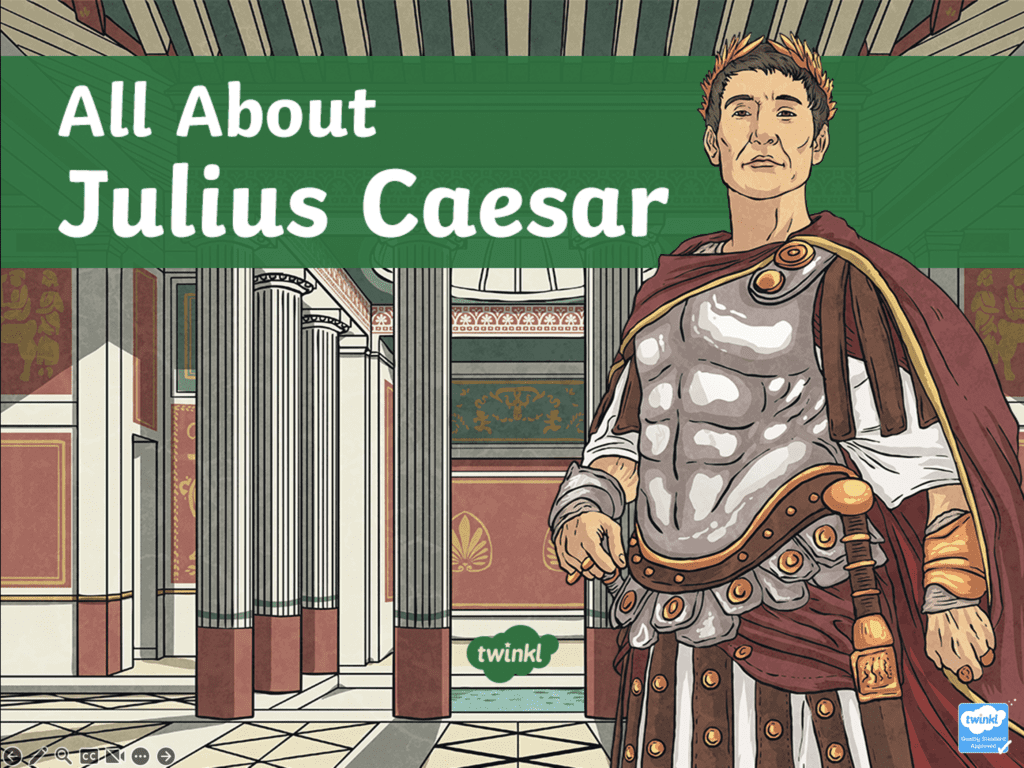
Twinkl’s KS2 All About Julius Caesar PowerPoint was a good starting point to give us a general idea of where he came from, why he was important and why Shakespeare would have chosen to write a tragedy about him.
With the historical knowledge under our belts it was time to get a grasp of the plot of the play. As with a lot of Shakespeare’s works based on real-life people there is a lot added/removed for dramatic effect, so it was important to learn the plot and make sure we understood what was going on.
We have a complete set of abridged Shakespeare works by Andrew Matthews, written specifically for children, which greatly simplify the Bard’s stories (sometimes way too much, leaving out quite important plot points; but that’s another story). So we raced through that in order to get a handle on the events of the play. I studied Julius Caesar at high school and even I had forgotten the fourth and fifth acts – the descent into civil war.
Then came the hard part: the language of Shakespeare.
Susan and I keep saying that reading Shakespeare makes no sense – you have to see it to understand what’s going on (and even then it can be difficult) so I wanted to find some resources which brought the play to life. I uncovered two things which formed the basis for our study of the language.
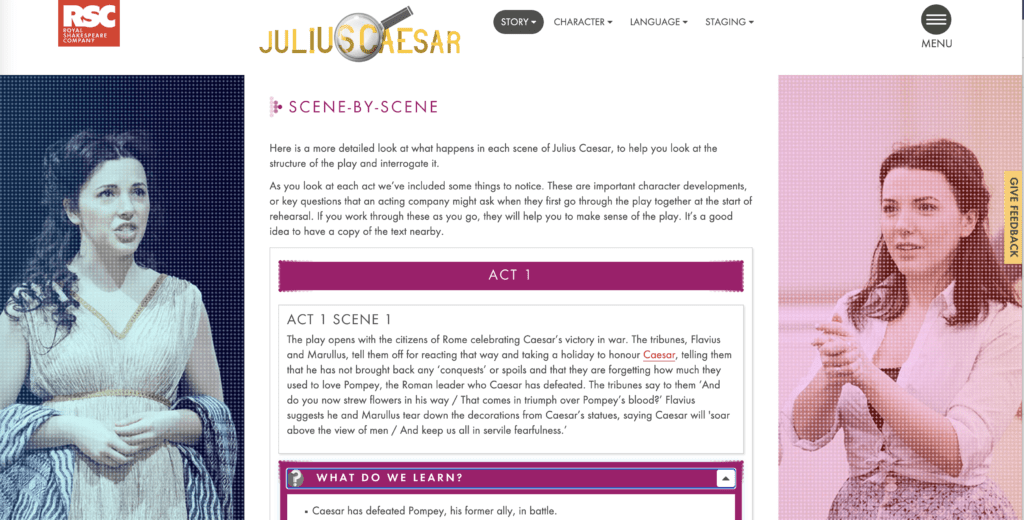
The first was a scene-by-scene breakdown of the play on the Royal Shakespeare Company’s website. It’s written specifically for high-school-aged children studying the plays. (There’s also a full Learning Zone of resources for the play on their website which has much more detail).
It examines each act, and each scene – briefly explaining the plot, and then, on a scene-by-scene basis, asking what we learn about the characters. It rounds up each act with a bullet-point list of the key things to notice – such as the frenzied mob’s murder of Cinna the poet following Caesar’s death, where, in their fury, they mistake him for Cinna the conspirator..
The great thing about this round-up is that it gives you both a broad overview of the plot, but also digs into some of the more subtle things you may miss if you’re not paying attention and shows you some of the conflicts which are being set up for later in the play.

The last, and best, resource we used was a series of videos on BBC Teach entitled Shakespeare Unlocked. The content is aimed at GCSE students, and there are a number of activities more suited to an older audience in a classroom setting, but the videos themselves are superb.
Featuring the actors from a 2012 RSC production of Julius Caesar filmed for BBC Four the videos explore three key scenes from the play: Cassius’s conversation with Brutus in Act 1: Scene 2; Caesar’s murder in Act 3: Scene 1; and the orations by Brutus and Mark Antony immediately after Caesar’s death in Act 3: Scene 2.
Along with each scene there are further videos where we see the cast explore the play more deeply, with interviews with the key players and exercises which help to expand on the meaning of the text. The exploration of the conversation between Cassius and Brutus, in particular, is really excellent and helped us get to the bottom of each character’s motivations.
Both girls were fairly gripped by the short scenes, and very engaged with the extra videos; responding really well to attempts to get at the meaning behind what was being said. I really feel that these videos opened up Shakespeare in a new way (for all of us) and made it far more accessible.
We rounded off our trip to Shakespeare’s version of ancient Rome with a trip of our own to the RSC in Stratford to see the latest version of the play. While I regret not spending a little more time on the fourth and fifth acts (the fourth act in particular seeming to completely fly over all of our heads), the time we’d spent studying meant that it was a far more enjoyable experience than it would have been otherwise. We even laughed at some of the jokes.
Next, we’re moving on to comedy with a look through A Midsummer Night’s Dream.
Other Shakespeare resources

The girls have really enjoyed reading the abridged versions of his plays by Andrew Matthews and actually asked to look at a play “properly” several years ago.
